Asynchronous Completion Token
Table of Contents
Overview
This post covers the following topics:
- The Asynchronous Completion Token pattern for efficiently managing state in asynchronous operations.
- A simplified implementation inspired by the Adaptive Communication Environment (ACE). The source code is available at https://github.com/yjung93/study_ACE_design_pattern
Asynchronous Completion Token (ACT) pattern [POSA2]
The Asynchronous Completion Token (ACT) also known as Active Demultiplexing, lets an application efficiently demultiplex and process the results of asynchronous operations that the application initiated.
Background
In a multi-threaded system, a client application may invoke operations on services and later receive the results asynchronously via completion events. When a completion event arrives, the client is responsible for demultiplexing it to the correct completion handler so the result can be processed.
To handle this efficiently, three factors matter:
- No direct dependency on client state: The service should not need to understand the client’s original context (and often cannot, because the client continues doing other work after initiating the operation).
- Low communication overhead: Avoid extra round trips or side channels just to figure out how the client should process a completion.
- Fast demultiplexing on completion: When the completion event arrives, the client should be able to quickly route it to the correct handler.
Solution
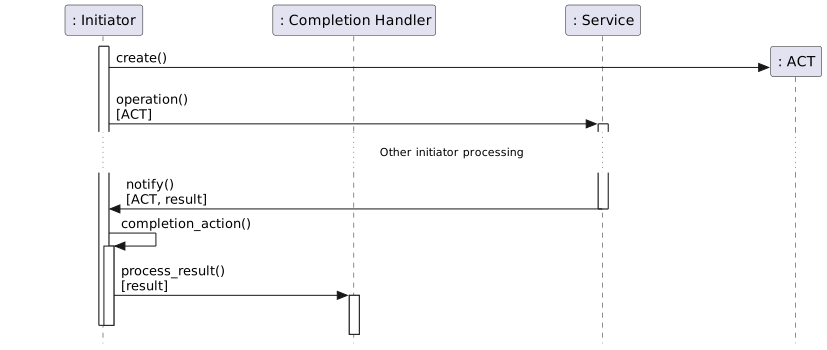
Whenever a client (the initiator) invokes an asynchronous operation on a service, it sends extra information describing how to handle the service’s response. When the operation completes, that information is returned unchanged, enabling the initiator to demultiplex and process the response efficiently.
In Detail:
- A client creates an
Asynchronous Completion Token (ACT)when it invokes an asynchronous operation on a service.
The ACT contains information that uniquely identifies the completion handler responsible for processing the operation’s response. - The ACT is passed to the service along with the operation request.
- The service keeps the ACT without modifying it.
- When the operation completes, the service responds to the initiator and includes the original ACT.
- The initiator uses the ACT to identify the correct completion handler and process the response.
Structure
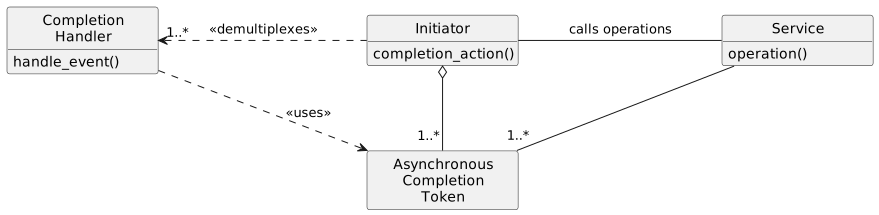
The Asynchronous Completion Token pattern has four participants:
- Service: Provides functionality and processes requests asynchronously.
- Initiator: Invokes operations on a service asynchronously and demultiplexes the service response to the appropriate handler.
- Completion Handler: A function or object that processes the result of a completed asynchronous operation.
- Asynchronous Completion Token (ACT): Contains information that identifies an initiator’s completion handler. It is passed to the service when the initiator requests an asynchronous operation and is returned unchanged when the operation completes, enabling efficient demultiplexing.
Class diagram
Dynamic
Simplified version of Implementation
Design Choices
This version keeps the core architectural ideas from ACE while intentionally skipping production-level complexity. For example, unlike the full ACE implementation which applied Factory and Bridge design patterns to support multiple platforms, this version supports only the POSIX platform and omits all Factory-related structures.
The participants of ACT in this post are implemented as part of a simplified Proactor framework, which is covered in Proactor framework.
The following framework is used as infrastructure for this implementation:
The source code is available at https://github.com/yjung93/study_ACE_design_pattern
Component Mapping
To implement this pattern, I mapped the ACT pattern components to the following C++ classes and associated OS kernel services:
| Pattern Role | Implementation class / OS kernel service |
|---|---|
| Service | POSIX.4 Asynchronous I/O |
| Initiator | AsynchReadStream / AsynchWriteStream |
| Completion Handler | Handler/ServiceHandler |
| Asynchronous Completion Token (ACT) | AsynchResult |
Framework Layer
The core components of ACT in the Proactor framework are:
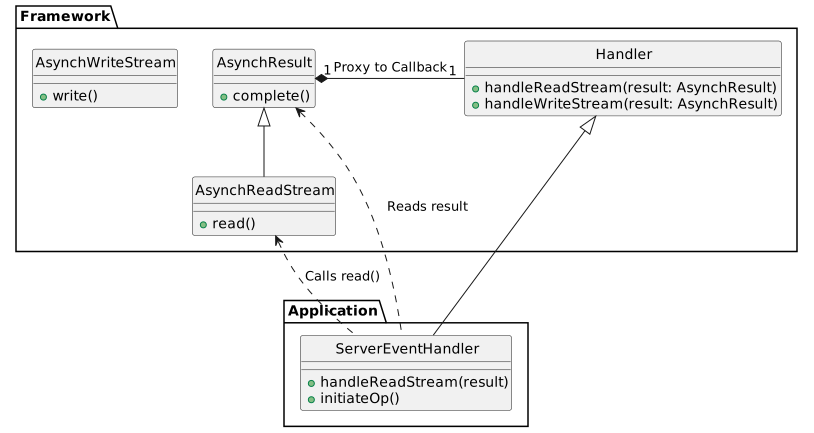
- Handler: An abstract base class for application-defined completion event handlers. It defines virtual methods like
handleReadStreamandhandleWriteStreamto process operation completions. - ServiceHandler: Extends
Handlerto support connection initialization (open). - AsynchResult: Represents the result of an asynchronous operation. It contains the status, bytes transferred, and acts as a carrier for the completion callback to the
Handler. - AsynchReadStream / AsynchWriteStream: Factory classes used by applications to initiate asynchronous read and write operations. They register each request with the
Proactor.
Application Layer
The example application demonstrates a hybrid approach where:
- Acceptor: Uses the Reactor pattern to synchronously listen for and accept new TCP connections. Upon acceptance, it creates a
ServerEventHandlerand hands over the new socket to the Proactor framework. - ServerEventHandler: A concrete
ServiceHandlerthat manages the lifecycle of a client connection. It initiates asynchronous reads and writes usingAsynchReadStreamandAsynchWriteStream.
Class diagram
The following diagram illustrates the relationship between the participants of the Asynchronous Completion Token pattern and the application classes. This diagram focuses on the classes involved in transporting the Asynchronous Completion Token.
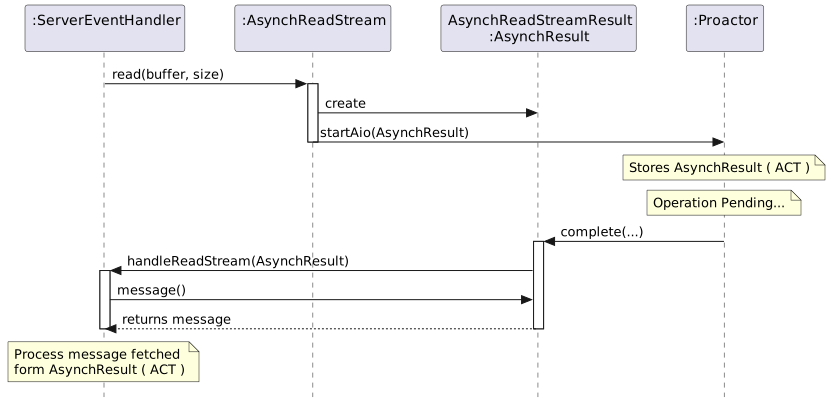
Sequence diagram
The sequence below illustrates the lifecycle of the ACT: from passing it during initiation to retrieving it during completion.
Directory and file structure
Related source files:
├── applications
│   ├── example_proactor
│   │   ├── Acceptor.cpp
│   │   ├── Acceptor.hpp
│   │   ├── MainClient.cpp
│   │   ├── MainServer.cpp
│   │   ├── ServerEventHandler.cpp
│   │   └── ServerEventHandler.hpp
├── framework
│   ├── proactor
│   │   └── 1_0
│   │       ├── AsynchPseudoTask.cpp
│   │       ├── AsynchPseudoTask.hpp
│   │       ├── AsynchReadStream.cpp
│   │       ├── AsynchReadStream.hpp
│   │       ├── AsynchResult.cpp
│   │       ├── AsynchResult.hpp
│   │       ├── AsynchWriteStream.cpp
│   │       ├── AsynchWriteStream.hpp
│   │       ├── Handler.cpp
│   │       ├── Handler.hpp
│   │       ├── NotifyPipeManager.cpp
│   │       ├── NotifyPipeManager.hpp
│   │       ├── Proactor.cpp
│   │       ├── Proactor.hpp
│   │       ├── ServiceHandler.cpp
│   │       └── ServiceHandler.hpp