HalfSync/HalfAsync Pattern
Table of Contents
- Overview
- Half-Sync/Half-Async pattern [POSA2]
- Simplified implementation
- Example Application using simplified Task framework
Overview
This post covers the following topics:
- The Half-Sync/Half-Async pattern for decoupling asynchronous operations from synchronous processing.
- A simplified implementation inspired by the Adaptive Communication Environment (ACE). The source code is available at https://github.com/yjung93/study_ACE_design_pattern
Half-Sync/Half-Async pattern [POSA2]
The Half-Sync/Half-Async pattern simplifies programming in concurrent systems by decoupling asynchronous and synchronous service processing without reducing performance.
Background
Concurrent software systems are often designed with a mixture of synchronous and asynchronous processing services.
- An asynchronous-processing-based design is efficient for handling time-critical events such as hardware interrupts or software signal events.
- A synchronous-processing-based design, in contrast, simplifies the programming effort.
To achieve both programming simplicity and high performance, we need to combine these two approaches in the software architecture.
Solution
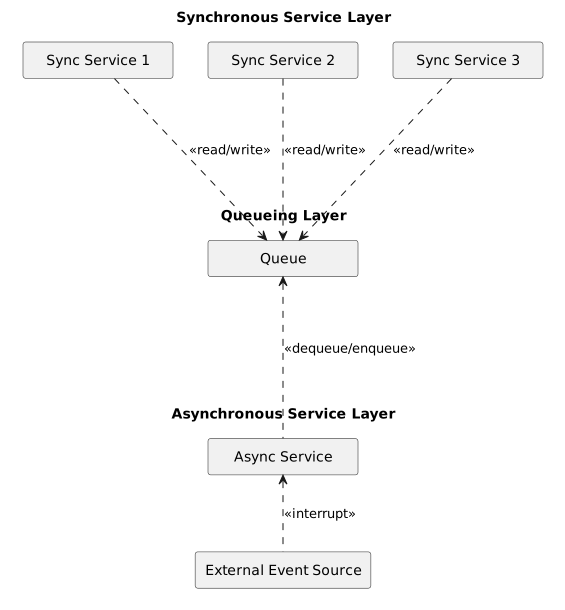
Decompose the system into two layers, a synchronous service layer and an asynchronous service layer, each running in a different thread. Add a message-queue layer between them so that the two layers communicate via the queue.
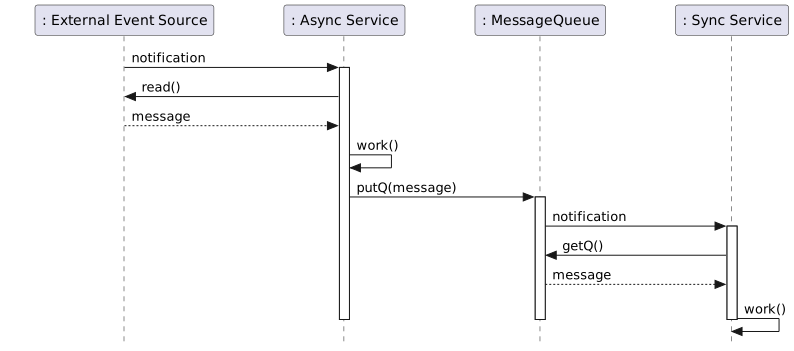
- The asynchronous service layer acts as a time-critical, low-level layer. It wakes up on events such as hardware interrupts or software signals from the underlying system and forwards the corresponding messages to the synchronous service layer via the message queue.
- The synchronous service layer implements higher-level, long-duration application services such as database queries or file reading/writing on a separate, independent thread.
Structure
This pattern is organized into three layers:
- Asynchronous (or reactive) service layer
- Synchronous service layer
- Message-queue layer between async and sync layers
Simplified implementation
The design pattern is applied to the Task Framework [SH03] of ACE.
The simplified Task framework is implemented to better understand how the pattern works and how it fits into a layered design.
This version keeps the core architectural ideas from ACE while intentionally skipping production-level complexity.
The source code is available at https://github.com/yjung93/study_ACE_design_pattern.
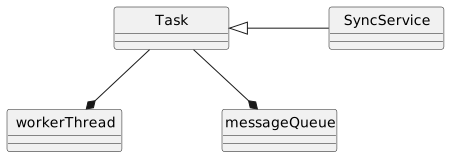
The framework consists of the following components:
- Task class
- Base class of synchronous services. It embeds a message queue and a worker thread, enabling the concrete class to perform services in the synchronous service layer.
- Message Queue
- The asynchronous service layer passes messages through this queue to the synchronous service layer.
- Worker Thread
- The thread on which the synchronous service runs. It wakes up when it receives a message from the asynchronous service layer and performs the synchronous application service.
- Sync service
- Concrete subclass of
Task. It receives messages from the asynchronous service layer and performs synchronous application services.
- Concrete subclass of
class diagram
sequence diagram
Example Application using simplified Task framework
Server application
- Demonstration server that waits for client connections, accepts them, and echoes messages received from clients.
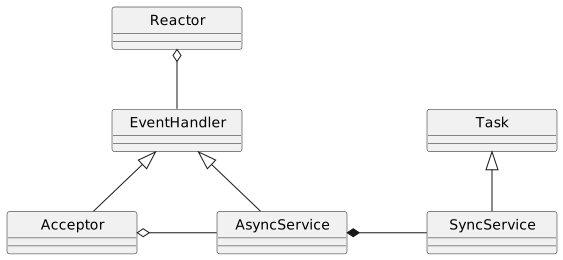
- Consists of
AcceptorandAsyncServicerunning on the main thread, andSyncServicerunning on a separate thread.
Accepror
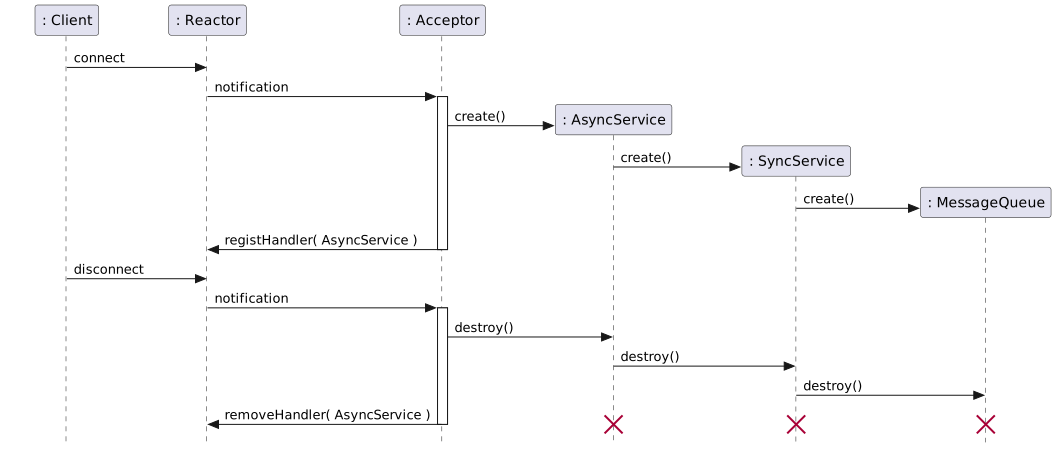
- Accepts incoming connections and creates
AsyncServiceandSyncServiceobjects when a connection is established. - Registers the
AsyncServiceobject with theReactorso it can receive callback events when a message arrives from a client.
AsyncService
- Receives external events from the
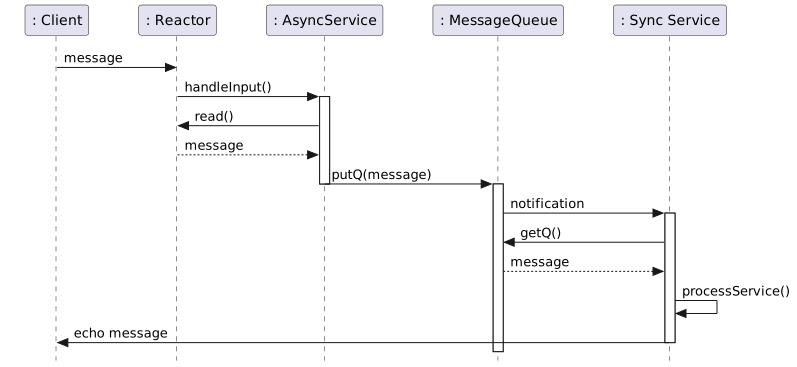
Reactorand forwards the corresponding messages toSyncServicevia the message queue.
SyncService
- Concrete subclass of the
Taskclass. - Processes synchronous services on a separate, independent thread.
class diagram
Sequence Diagram
Interoperation between Async and Sync service layer
Life Cycle of Async/Sync Service component
Directory and file structure
Related source files:
├── applications
│   ├── example_half-sync_half-async
│   │   ├── Acceptor.cpp
│   │   ├── Acceptor.hpp
│   │   ├── AsyncService.cpp
│   │   ├── AsyncService.hpp
│   │   ├── MainClient.cpp
│   │   ├── MainServer.cpp
│   │   ├── SyncService.cpp
│   │   └── SyncService.hpp
├── framework
│   ├── reactor
│   │   └── 1_0
│   │       ├── EventHandler.cpp
│   │       ├── EventHandler.hpp
│   │       ├── Reactor.cpp
│   │       └── Reactor.hpp
│   └── task
│       └── 1_0
│           ├── Task.cpp
│           └── Task.hpp